
Why the Transition Zone Needed a Shadow
- January 5, 2026
- Posted by: DrGlenBrown2
- Category: Blog
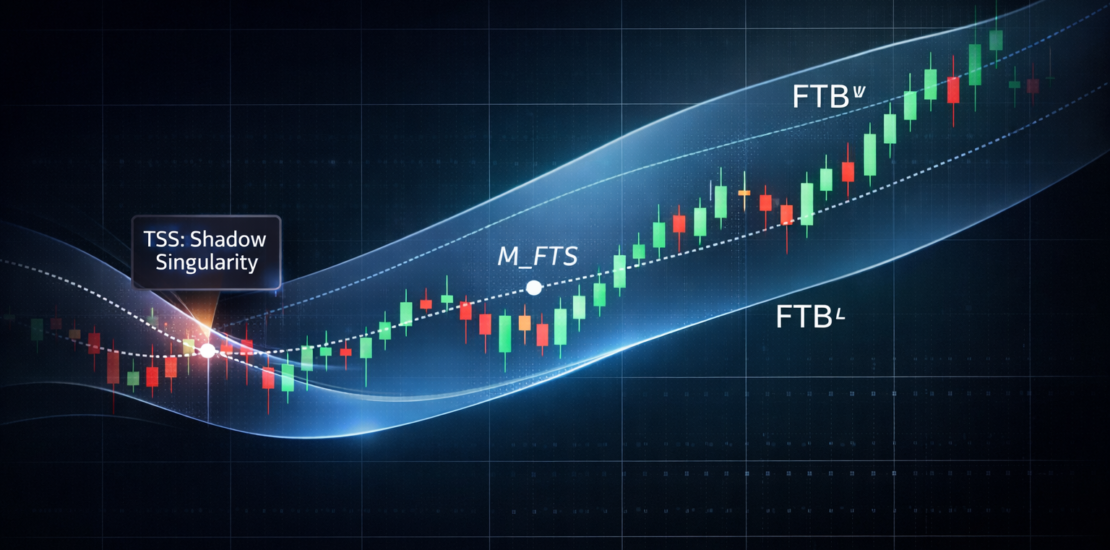
Forward Transition Shadow Series — Part 1
This article expands on the Forward Transition Boundary (FTB) and Forward Transition Shadow (FTS) doctrine within the GATS Framework. The full formal doctrine is available here: Read the complete FTB & FTS doctrine .
1. The Role of the Transition Zone in Market Structure
Within the GATS Framework, the Transition Zone—defined by EMA 16 through EMA 25—serves a precise structural role. It is the bridge between acceleration and value, where trends are either accepted, negotiated, or rejected.
When price is above the Transition Zone, momentum and acceleration dominate. When price is below it, value and corrective forces take precedence. When price trades inside it, the market is undecided—negotiating its next state.
This interpretation has proven robust across asset classes and timeframes. However, experience revealed a critical limitation.
2. The Structural Limitation of “Current-State Only” Analysis
Traditional EMA analysis—including EMA zones—evaluates where structure is now. It does not explicitly encode where structure believed it was going.
This distinction matters most during:
- Late-stage trends approaching exhaustion
- High-compression consolidation before expansion
- False breakdowns and false breakouts around EMA 25
In these environments, price may still appear structurally valid relative to EMA 16–25, while the underlying structural continuity is already degrading.
In other words, the market may still respect the Transition Zone visually, while violating it structurally.
3. The Missing Dimension: Structural Memory
Markets do not move purely in the present. They carry memory—of volatility, of structure, of prior equilibrium.
The GATS volatility doctrine (ATR, DAATS, compression and expansion) already accounts for volatility memory. What was missing was an explicit representation of structural memory.
The key question became:
Where did the Transition Zone believe structure was forming half a cycle ago, and how does price behave relative to that belief now?
4. Why a Shadow, Not Another Indicator
The solution was not to introduce a new oscillator, filter, or momentum tool. Doing so would add lag, complexity, and redundancy.
Instead, the Transition Zone itself was used as the source of truth. By forward-staging its boundaries by approximately half their period, a shadow of prior structure is projected into the present.
This shadow does not predict price. It does not forecast direction. It simply answers a deeper structural question:
Is current price still operating within the memory of prior structural agreement?
5. From Zone to Corridor: A Conceptual Shift
The Transition Zone alone defines a boundary. The Forward Transition Shadow defines a corridor.
This corridor represents:
- Where structure was recently accepted
- How far structure has drifted since then
- Whether that drift remains coherent or is collapsing
Once this corridor exists, price interaction becomes qualitatively different:
- Price above the shadow implies structural dominance
- Price inside the shadow implies negotiation
- Price below the shadow implies structural invalidation
6. What the Shadow Makes Visible
With the Forward Transition Shadow in place, several phenomena become immediately clearer:
- Why some pullbacks are healthy while others fail
- Why trends often break before classic EMA crosses
- Why overtrading during compression leads to drawdown
Most importantly, it introduces a formal concept of structural stand-down—a state where participation is paused not because price reversed, but because structure lost continuity.
7. Position of This Article Within the Doctrine
This article provides conceptual grounding only. It does not redefine rules, parameters, or thresholds.
All formal definitions—including Forward Transition Boundaries (FTBᵁ/FTBᴸ), the Forward Transition Shadow (FTS), shadow width, midline equilibrium, and the Transition Shadow Singularity (TSS)—are defined exclusively in the master doctrine.
Readers are encouraged to review the full doctrine here: Forward Transition Boundary (FTB) & Forward Transition Shadow (FTS) .
Next in the series:
Forward Transition Shadow Series — Part 2: Understanding FTBᵁ and FTBᴸ as Forward-Staged Structure