
BTCUSD Structural Hierarchy: A Research Note on Bitcoin’s Monthly Zone 5 Test
- June 8, 2026
- Posted by: DrGlenBrown2
- Categories: Research & Publications, Sovereign Market Intelligence
By Dr. Glen Brown
Global Accountancy Institute, Inc. & Global Financial Engineering, Inc.
A companion research note to the Sovereign Market Intelligence Series · Pillar II — The Symbol Chronicle · Issue No. 005
Research Overview
Bitcoin continues to provide one of the most instructive case studies in modern market structure analysis. Its volatility, cyclicality, and institutional relevance make BTCUSD an important instrument for studying the relationship between price, trend, structural hierarchy, and multi-timeframe interpretation.
This research note is published by Global Accountancy Institute, Inc. as a companion to the full market-intelligence publication released by Global Financial Engineering, Inc. The GFE article provides the full sovereign market decode. This GAI companion note frames the same analysis as a research and learning exercise in structural market interpretation.
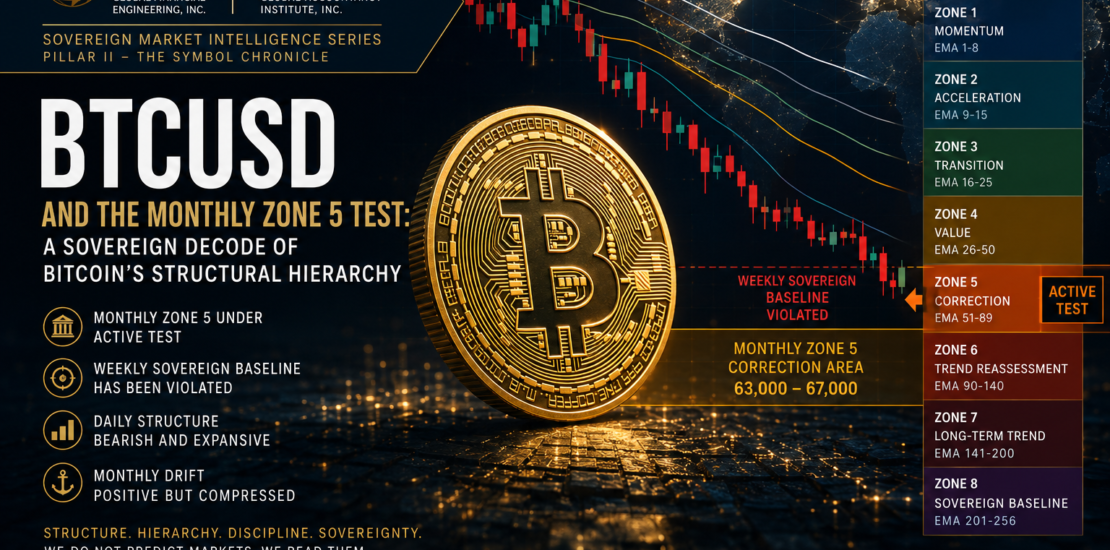
The central issue examined is Bitcoin’s test of the Monthly Zone 5 Correction area, while the Weekly Sovereign Baseline has been violated, the Daily structure remains bearish and expansive, and the Monthly Drift remains positive but compressed.
This is not a simple bullish or bearish condition. It is a live example of structural conflict across the timeframe hierarchy.
Read the full canonical GFE publication here:
BTCUSD Monthly Zone 5 Test: Bitcoin Structural Hierarchy Analysis by GFE & GAI
Why This BTCUSD Reading Matters
The BTCUSD reading matters because it demonstrates the danger of interpreting markets through isolated timeframes. A trader looking only at intraday movement may see recovery. A trader looking only at the Daily timeframe may see bearish expansion. A trader looking only at the Monthly timeframe may still see a long-term bullish structure under pressure.
The GFE and GAI methodology resolves this conflict through the doctrine of structural hierarchy.
Under this approach, the Monthly timeframe carries the highest structural authority. The Weekly timeframe governs the intermediate structure. The Daily timeframe governs the near-term regime. The intraday timeframes express movement within those higher structures.
Therefore, the market is not judged by how many timeframes appear bullish or bearish. It is judged by the authority of the timeframes involved.
The hierarchy of timeframes is not a democracy. A single Monthly Drift condition can outweigh several intraday signals.
The Core Structural Reading
The BTCUSD analysis identified four major structural facts:
- Monthly Zone 5 is under active test. This zone represents the Correction area within the Eight-Zone EMA Architecture.
- The Weekly Sovereign Baseline has been violated. This is a serious condition because the Sovereign Baseline represents the deepest weekly structural reference.
- The Daily structure remains bearish and expansive. This indicates that near-term governing pressure has not yet been resolved.
- The Monthly Drift remains positive but compressed. This preserves the long-term classification of the decline as a correction rather than a confirmed structural reversal.
Together, these readings create a state of structural tension. Bitcoin is not in a simple recovery condition. It is not in a simple collapse condition either. It is in a higher-order structural test.
The Educational Value of Zone 5
Within the Eight-Zone EMA Architecture, Zone 5 is not an ordinary technical level. Zone 5 represents the Correction Zone, built around EMA 51 through EMA 89. It is the area where a market begins to reveal whether it is merely correcting within the governing trend or beginning to transition into deeper reassessment.
For BTCUSD, the Monthly Zone 5 area has become the key structural battleground. If price holds this area and begins to reclaim higher zones, the framework may continue to classify the decline as a correction within the long-term structure. If price fails this area and Monthly Drift continues compressing toward a negative cross, the framework must begin reading deeper structural reassessment.
This is why Zone 5 matters. It is not a prediction point. It is a classification boundary.
Zone 5 is where the market asks whether the trend is correcting or being reassessed.
The Importance of the Weekly Sovereign Baseline
The Weekly Sovereign Baseline is one of the most important features in this BTCUSD reading. It represents the deepest weekly structural layer within the Eight-Zone EMA Architecture. When price falls below this region, the market has moved outside the full weekly zone structure.
From a research perspective, this is significant because it changes how bounces should be interpreted. A bounce below the Weekly Sovereign Baseline is not the same as a bounce above it. Below the baseline, the market is still operating from a structurally impaired weekly position. Above the baseline, the market begins the process of repairing weekly structure.
This is why the GFE publication emphasized the importance of reclaiming the Weekly Sovereign Baseline area before interpreting any bounce as genuine structural recovery.
Monthly Drift as the Final Structural Anchor
The most important stabilizing factor in the BTCUSD reading is the Monthly Drift. Although the Weekly and Daily structures are under pressure, the Monthly Drift remains positive but compressed.
This distinction is central to the GFE and GAI methodology. Monthly Positive-Compress means the long-term structural current remains positive, but its strength is narrowing. It is a warning condition, not yet a full reversal condition.
As long as Monthly Drift remains positive, the framework can continue to classify the decline as a correction within the long-term governing structure. If Monthly Drift crosses negative, the classification changes. At that point, the framework would begin treating the condition as a deeper structural reassessment.
This is the value of structural hierarchy. It prevents the analyst from overreacting to short-term weakness while also preventing complacency when higher-timeframe compression is clearly developing.
Two Possible Structural Outcomes
1. Zone 5 Holds
If Monthly Zone 5 holds and BTCUSD reclaims the Weekly Sovereign Baseline, the framework would begin reading early structural repair. In that case, the lost Monthly Value Zone becomes the next major area of interest, and the framework would monitor whether Daily negative expansion begins compressing toward neutral.
2. Zone 5 Fails
If Monthly Zone 5 fails and price remains below the Weekly Sovereign Baseline, the framework would begin reading deeper structural reassessment. In that case, Monthly Zone 6 becomes the next major structural reference, while Monthly Drift would require close monitoring for further compression toward a potential negative cross.
The key is that both outcomes are defined before the market resolves. This is what disciplined structural analysis requires.
Research Conclusion
The BTCUSD Monthly Zone 5 test is a powerful example of why market analysis must be governed by structure, not emotion. Bitcoin is showing conflict across the timeframe hierarchy. Intraday conditions may improve while Daily and Weekly structures remain impaired. At the same time, the Monthly Drift may continue preserving the long-term structural classification until proven otherwise.
The lesson is clear: financial markets must be read through hierarchy, architecture, drift, compression, expansion, and structural consequence.
For this reason, the BTCUSD reading is not only a Bitcoin analysis. It is a case study in disciplined sovereign market intelligence.
Read the full canonical article on Global Financial Engineering, Inc.:
BTCUSD Monthly Zone 5 Test: Bitcoin Structural Hierarchy Analysis by GFE & GAI
Business Model Clarification
Global Accountancy Institute, Inc. and Global Financial Engineering, Inc. are closed-loop proprietary trading institutions. The firms do not accept clients, do not manage external investor funds, do not operate as conventional retail proprietary trading firms, and do not sell trading signals, investment products, or public trading programs.
Their institutional focus is proprietary trading, internal research, financial engineering, structural market analysis, and the development of advanced internal governance frameworks.
About the Author
Dr. Glen Brown is the President & CEO of Global Accountancy Institute, Inc. and Global Financial Engineering, Inc. He is a financial engineer, proprietary trading strategist, researcher, and thought leader with more than 25 years of experience across finance, investments, accounting, trading, technology, and institutional governance.
His work focuses on proprietary trading systems, sovereign financial engineering, volatility governance, structural market analysis, and the development of disciplined frameworks for interpreting complex financial markets.
General Disclaimer
This publication is provided for educational, research, and thought-leadership purposes only. It does not constitute investment advice, financial advice, trading advice, a recommendation, or a solicitation to buy or sell any financial instrument, cryptocurrency, derivative, security, or other asset.
Trading and investing in financial markets, including cryptocurrencies such as Bitcoin, involve substantial risk and may result in significant financial loss. Market conditions can change rapidly, and past performance, historical structure, or analytical interpretation does not guarantee future results.
Readers are solely responsible for their own financial decisions and should seek independent professional advice where appropriate. Global Accountancy Institute, Inc., Global Financial Engineering, Inc., and Dr. Glen Brown accept no liability for any loss or damage arising from the use of this publication or any reliance placed upon its contents.