
Understanding FTBᵁ and FTBᴸ as Forward-Staged Structure
- January 5, 2026
- Posted by: DrGlenBrown2
- Category: Quantitative Trading Systems
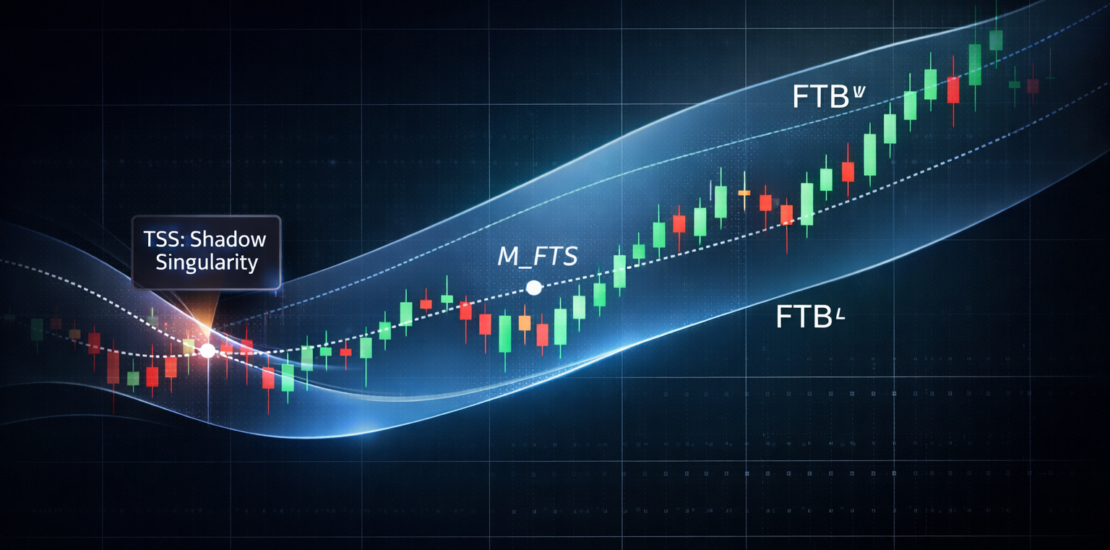
Forward Transition Shadow Series — Part 2
This article expands on the Forward Transition Boundary (FTBᵁ / FTBᴸ) and Forward Transition Shadow (FTS) doctrine within the GATS Framework. The complete and authoritative doctrine is published here: Forward Transition Boundary (FTB) & Forward Transition Shadow (FTS) .
1. Why “Forward-Staged” Does Not Mean Predictive
A common misunderstanding when encountering forward-shifted structure is to assume that it represents a forecast or prediction of price. The Forward Transition Boundaries do neither.
FTBᵁ and FTBᴸ are not projections of price. They are projections of prior structure.
This distinction is essential:
- Predictive indicators attempt to estimate future price behavior.
- FTB lines re-express where structure was, staged into the present.
The Forward Transition Boundary answers a structural question, not a directional one:
Is current price still respecting the memory of how structure was organized half a cycle ago?
2. The Half-Cycle Principle
The forward staging applied to the Transition Zone uses approximately 50% of the underlying EMA period:
- EMA 25 → shifted ~13 bars → FTBᵁ
- EMA 16 → shifted ~8 bars → FTBᴸ
This is not an optimization exercise. It is a structural choice.
A half-cycle shift preserves relevance while avoiding distortion:
- Too small a shift collapses into noise.
- Too large a shift becomes detached from current structure.
Half-cycle staging captures recent structural belief— close enough to matter, far enough to reveal drift.
3. FTBᵁ and FTBᴸ as Structural Memory Lines
The Transition Zone (EMA 16–25) defines where structure is negotiating now. The Forward Transition Boundaries define where that same structure was negotiating recently.
This creates a time-separated comparison:
- EMA Zone: current structural agreement
- FTB Lines: remembered structural agreement
When current price diverges meaningfully from remembered structure, the market is no longer evolving smoothly. It is either accelerating, compressing, or destabilizing.
4. Why Two Boundaries Are Required
A single forward line provides directional reference. Two forward lines provide context.
FTBᵁ and FTBᴸ together form a band that preserves:
- Structural thickness
- Compression vs expansion information
- Ordering integrity
Without both boundaries, it would be impossible to:
- Measure structural width
- Detect collapse or inversion
- Identify early regime fragility
5. Forward-Staged Structure vs Repainting
Another frequent concern is whether forward-staged boundaries “repaint.” They do not.
Each FTB value is derived entirely from historical EMA data. Once a bar closes, its contribution to the forward-staged line is fixed.
The boundaries move only because new information arrives, not because past values are altered. This is structurally equivalent to all EMA-based calculations within GATS.
6. How Traders Should Think About FTB Interaction
Forward Transition Boundaries are not entry triggers. They are structural references.
Traders should observe:
- Whether price respects, negotiates, or violates the forward boundaries
- How long price remains inside the band
- Whether violations are temporary or decisive
These observations inform posture, not impulse. They determine whether participation is appropriate, cautious, or suspended.
7. Relationship to the Master Doctrine
This article provides interpretive clarity only. It does not redefine formulas, parameters, or thresholds.
All formal definitions—including FTBᵁ, FTBᴸ, the Forward Transition Shadow, shadow width, midline equilibrium, and the Transition Shadow Singularity (TSS)— remain exclusively defined in the master doctrine:
Forward Transition Boundary (FTB) & Forward Transition Shadow (FTS) .
Next in the series:
Forward Transition Shadow Series — Part 3: The Forward Transition Shadow as a Negotiation Corridor
About the Author
Dr. Glen Brown is President & CEO of Global Accountancy Institute, Inc. and Global Financial Engineering, Inc., proprietary trading firms specializing in systematic trading, institutional risk engineering, and multi-timeframe market structure design through the GATS Framework.
Business Model Clarification
Global Accountancy Institute, Inc. and Global Financial Engineering, Inc. operate as proprietary trading firms deploying internal capital only. Any frameworks, models, or concepts discussed are presented for educational and informational purposes and do not constitute an offer to manage money, provide investment advisory services, or solicit clients.
General Disclaimer
This material is provided for educational purposes only and does not constitute financial, investment, legal, or tax advice. All decisions are the sole responsibility of the reader. Examples are illustrative and not indicative of future results.
Risk Disclaimer
Trading financial instruments involves substantial risk and is not suitable for all participants. You may lose some or all of your invested capital. Past performance is not indicative of future results. Always assess your risk tolerance and seek independent professional advice where appropriate.