


Transformative Learning Experiences
“Explore how our innovative education model is shaping the future of finance. Our unique blend of theoretical knowledge and practical application prepares our students for the complexities of the global financial landscape.”

Global Reach, Local Impact
“Discover the global footprint of Global Accountancy Institute, Inc. With students and alumni from over [X number of countries], our community is making a significant impact on local economies and the global finance industry.”

Cutting-Edge Research and Insights
“Dive into the groundbreaking research conducted by our faculty and students. From advancing financial technologies to developing sustainable investment strategies, our contributions are at the forefront of financial innovation.”

A Legacy of Excellence
“With over 25 years of dedication to financial education and innovation, our legacy is not just defined by what we’ve achieved but by the impact we continue to make on the world.”
Sustainability at Our Core
“Understanding the critical role finance plays in sustainability, we integrate environmental, social, and governance (ESG) principles into our curriculum and research, preparing students to make responsible financial decisions.”
Research That Reshapes the Financial Landscape
“Our cutting-edge research initiatives are paving the way for new financial theories and technologies, setting new standards and reshaping the future of finance and accountancy.”

-

BTCUSD Structural Hierarchy: A Research Note on Bitcoin’s Monthly Zone 5 Test
By Dr. Glen BrownGlobal Accountancy Institute, Inc. & Global Financial Engineering, Inc. A companion research note to the Sovereign Market Intelligence Series · Pillar II — The Symbol Chronicle · Issue No. 005 Research Overview Bitcoin continues to provide one of the most instructive case studies in modern market structure analysis. Its volatility, cyclicality, and
June 8, 2026Read More -
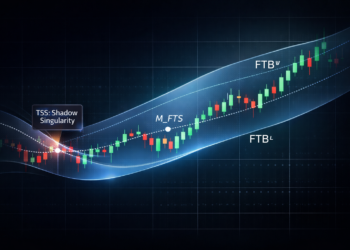
Common Misinterpretations and Misuse of the Forward Transition Shadow
This article clarifies common misinterpretations of the Forward Transition Shadow, protecting the integrity of the GATS structural doctrine.
January 9, 2026Read More -
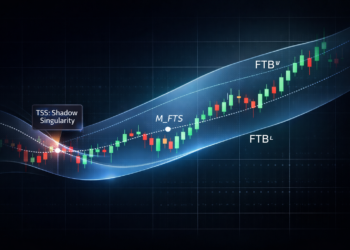
How FTS Changes Risk Posture, Not Just Entries
The Forward Transition Shadow regulates risk posture before entries, shifting exposure based on structural coherence rather than signals alone.
January 9, 2026Read More -
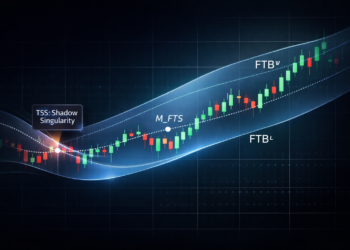
Forward Transition Shadow Across Timeframes
The Forward Transition Shadow reveals structural stability and stress across timeframes, ensuring lower-timeframe decisions respect higher-timeframe regimes.
January 6, 2026Read More -
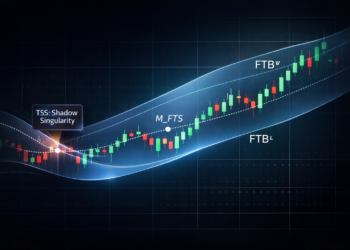
Transition Shadow Singularity (TSS): Regime Stand-Down and Structural Reset
The Transition Shadow Singularity marks a collapse of structural memory, enforcing a stand-down period until a new regime coherently forms.
January 5, 2026Read More -
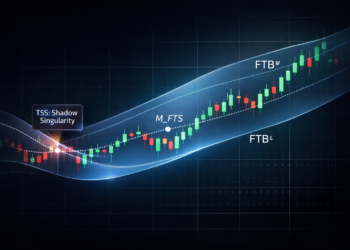
Shadow Width, Compression, and Structural Stress
Shadow width within the Forward Transition Shadow exposes structural stress and compression, providing early warning of regime instability before price reversals.
January 5, 2026Read More -
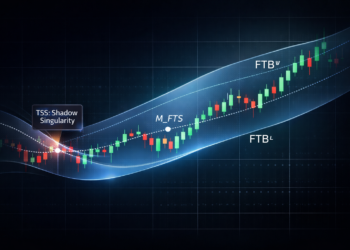
The Forward Transition Shadow as a Negotiation Corridor
The Forward Transition Shadow reframes the Transition Zone as a negotiation corridor, allowing traders to classify dominance, pullbacks, and structural failure with clarity.
January 5, 2026Read More -
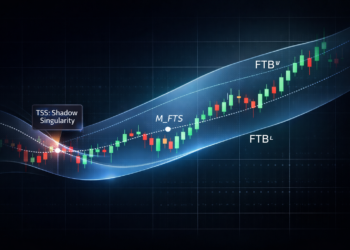
Understanding FTBᵁ and FTBᴸ as Forward-Staged Structure
A new GATS structural doctrine that projects the Transition Zone forward into a “shadow band” to filter regimes, validate pullbacks, and enforce stand-down rules when structure collapses and inverts.
January 5, 2026Read More -
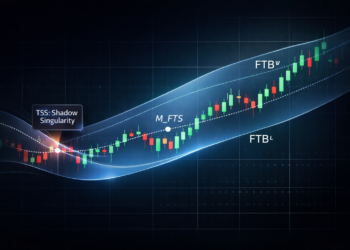
Why the Transition Zone Needed a Shadow
A new GATS structural doctrine that projects the Transition Zone forward into a “shadow band” to filter regimes, validate pullbacks, and enforce stand-down rules when structure collapses and inverts.
January 5, 2026Read More -
EGAML → GATS Implementation: How the State Matrix Becomes a Trade Filter
Translating EGAML into executable GATS logic through state-gated participation and risk controlTranslating EGAML into executable GATS logic through state-gated participation and risk control
January 4, 2026Read More