The Machine Readings · Paper VII
A sub-series of the Public Doctrine Series
The Toll and the Clock
Why, when the bank and the stop are fixed at birth, speed decides when a position resolves and the cost of entering decides which way the book goes
Dr. Glen Brown · President & CEO, Global Financial Engineering, Inc. and Global Accountancy Institute, Inc.
GFE-PUB-MR-20261101-G-CS · 1 November 2026
How to read this paper. The Machine Readings reason from a trading machine’s own records rather than from commentary on markets. Every claim of fact carries one of three marks. [W] Witnessed: read directly from a ledger or journal the machine wrote, or from the venue’s price record. [D] Derived: computed from witnessed figures by a method this paper gives. [I] Inferred: an interpretation the evidence supports but does not compel. A sentence without a mark is argument, not evidence.
About the case. The case in this paper is an illustration built from operating data. Every result is stated in units of the position’s own risk (R, where one R is the distance to the stop), never in money; the venue, the account and the dates are withheld, and nothing here reports the results of any account. The reasoning and the measurements are unaltered.
I. The Reading
A position born under a fixed bank and a fixed stop can end in only two ways: it reaches the bank, a distance D from entry, or it reaches the stop, a distance S on the other side. Everything else about it, how long it takes, how far it wanders, what the market does meanwhile, is a matter of the road and not of the destination. This paper is about which of the many things that differ between positions decides the destination, and therefore the sign of the book.
The question arose from the machine running the book, which over six weeks bore about a thousand positions across currencies, indices, single stocks, exchange-traded funds and digital assets. [W] The book lost over the period, and the losses were not spread evenly. [W] The natural first reading was about speed. The positions that banked quickly never died; every death was among the positions that were still open when the quick ones had finished. [W] So it seemed that the book lost on slow positions: on afternoons when momentum fades, on instruments that move little, on births that could not reach the bank before the market turned. A rule that preferred fast births looked like the cure.
That reading was wrong, and the way it was wrong is the first lesson of this paper. Sorting positions into fast and slow by whether they had banked within a horizon uses the outcome to define the class. A death takes time to happen, so it can only appear among the positions that have not yet banked; it is slow by construction. [D] To ask whether speed decides the outcome, speed must be measured at birth, before the outcome exists. When it was, the answer was no.
Speed decides when a position resolves. It does not decide which way. What decides which way, when the bank and the stop are fixed, is the cost of entering: the spread paid at birth, measured against the bank it must cross. This paper calls that ratio the toll.
II. The Mechanism
Volatility buys time, not odds
Consider a price that moves as a fair random walk, with no drift, and a position that will close at whichever comes first: a gain of D or a loss of S. The probability that the gain comes first is S/(D+S). [D] The result is old: it is the gambler’s ruin of classical probability, and it follows in one line from the fact that a fair game stopped at a bounded time remains fair. What matters for this paper is what does not appear in it. Volatility does not appear. A walk that moves ten times faster reaches the same two barriers in the same proportions; it only gets there sooner. [D] Speed rescales the clock and leaves the odds alone.
In the case the bank is a small fixed fraction of the unit and the stop is never smaller than the unit, so D/S is small; its median across the births was 0.044. [W] So the fair walk banks about 95.5 per cent of the time, earning D/S of an R on each of those and losing one R on the rest. The two exactly cancel: a fair walk under a fixed bank and stop has an expected result of zero, whatever its speed. [D]
What the machine measured
To test the first half of that claim the machine’s one-minute price record for every symbol the book traded was replayed against each position’s own bank and stop. [W] Each birth was given a speed at birth: the volatility of its symbol over its lane’s natural horizon, measured in banks. The 667 births that had resolved were ranked by that speed and cut into four equal groups. [D]
Figure 1. Speed at birth: the share that bank first, and how long they take
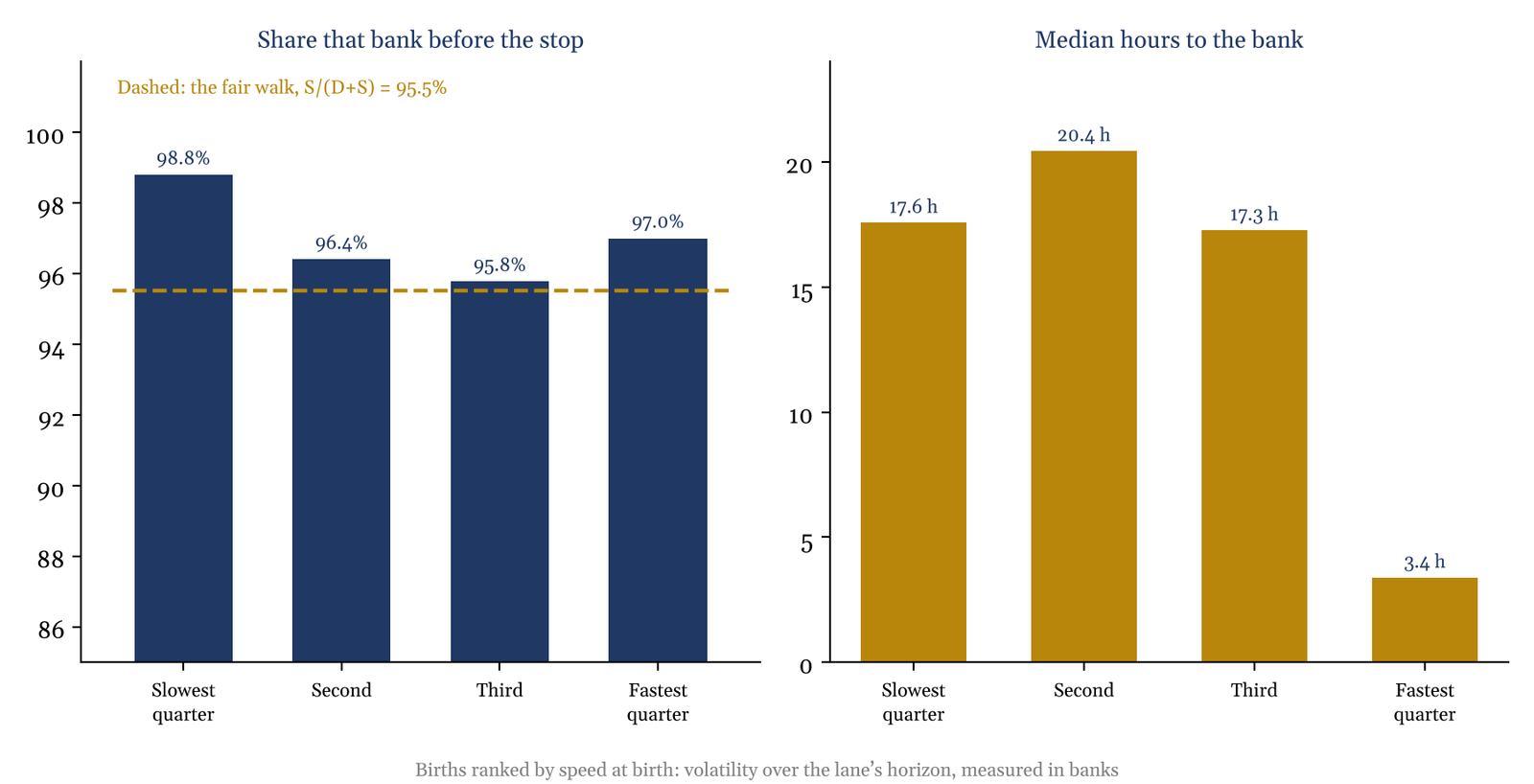
Left: the share of resolved births in each speed quarter that reached the bank before the stop, against the fair walk’s S/(D+S). Right: the median hours from birth to bank. Speed at birth is volatility over the lane’s horizon divided by the bank distance. 667 resolved births; derived from the one-minute price record and the birth ledger. Results are in units of risk; money, venue, account and dates are withheld.
The fastest quarter banked in a median of 3.4 hours; the slowest in 17.6. [D] Speed moved the time to bank by a factor of five. It moved the share that banked by three points at most, and not in order: the slowest quarter banked first 98.8 per cent of the time, the fastest 97.0, the two middle quarters 96.4 and 95.8. [D] Every quarter banked a little more often than the fair walk’s 95.5 per cent, which is the machine’s edge, and none in proportion to its speed. [D]
The toll moves the start of the walk
Now add a cost. A position bought at the ask and valued at the bid begins its life a spread below where it was priced. The bank is measured from the price, so it is now D plus the spread away; the stop is S minus the spread away. The probability of banking first falls to (S − spread)/(D + S), and the expected result of a driftless walk is no longer zero. It is minus the spread divided by the stop. [D] Writing τ for the spread as a share of the bank, the expected result of every birth is
E = edge − τ · D/S
where the edge is whatever the machine’s entry adds to a fair walk. [D] The toll is charged on every birth, whatever its outcome and whatever its speed. It is charged in the coin of the bank and paid in the coin of the stop, which is why a small spread against a small bank can outweigh a real edge.
The machine’s own records test this directly. Among the 667 resolved births, those born with a toll of one-fifth of the bank or less banked first 98.1 per cent of the time; those born dearer banked first 96.1 per cent. [D] The identity predicts a gap of 1.7 points from the spreads actually paid; the books show 2.0. [D] In results, the cheap births earned +0.029 R each and the dear births +0.005 R. [D] Add back each birth’s own toll and the two groups carried almost the same edge before cost, +0.032 R and +0.026 R. [D] The signal was the same everywhere. What differed was the price of acting on it.
Figure 2. The toll at birth and the result per birth
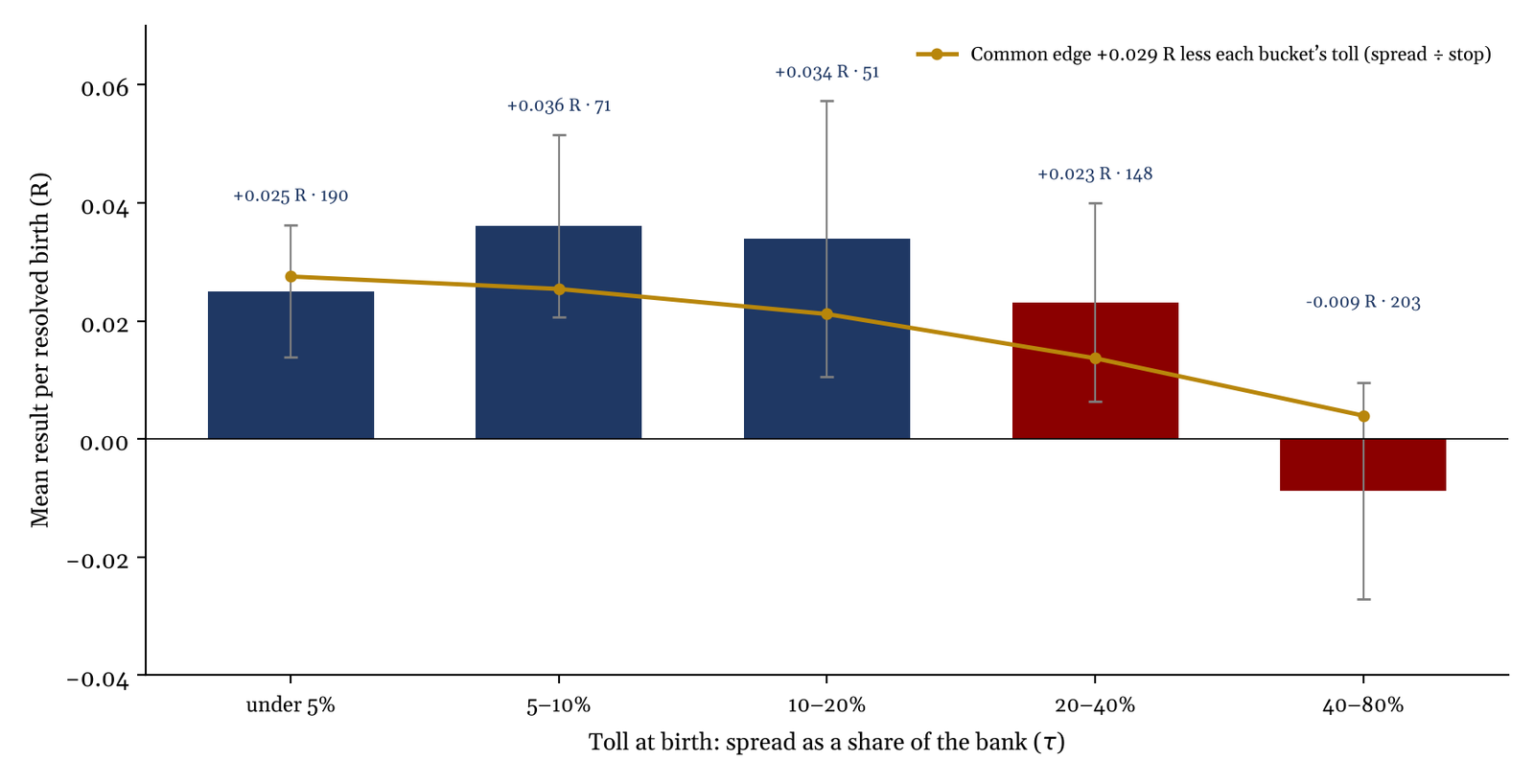
Mean result per resolved birth (bars, with one standard error) by the toll at birth, the spread as a share of the bank. The gold line is a single common edge of +0.029 R less each bucket’s average toll in R (spread divided by stop): the identity, with no further fitting. Navy: births the toll law now admits; red: births it refuses. One bucket of four births above 80 per cent is omitted. Results are in units of risk; money, venue, account and dates are withheld.
III. The Argument
First proposition: with the bank and the stop fixed, speed is free and the toll is not
Volatility, momentum, the hour of the day and the liveliness of a market all change how soon a position meets one of its barriers. None of them changes which barrier is nearer, because the barriers are fixed at birth in units of price. [D] The only quantity that moves the start of the walk is what is paid to begin it. A machine that wants to change the sign of its book, rather than its speed, must look at its costs. [I]
Second proposition: the toll is a property of an instrument at the scale of its bank
A spread of five cents is nothing against a bank of five dollars and everything against a bank of ten cents. The toll is therefore not a property of a venue or of an asset class but of each instrument at the scale at which the machine banks it. [D] By class the median tolls at birth ran from 2 per cent of the bank in currencies to 37 per cent in single stocks and above 40 per cent in exchange-traded funds and digital assets, and, apart from the digital assets, whose final week is explained under Table 1, the classes ranked by result exactly as they ranked by toll. [W] [D] Single stocks were more than half the births and paid one of the highest tolls. [W]
Table 1. The toll by class, and the result per birth
| Class | Births | Median toll at birth (τ) | Toll in R (mean) | Result per birth (R) |
|---|---|---|---|---|
| Currencies | 198 | 2.0% | 0.002 | +0.015 |
| Indices | 108 | 8.1% | 0.005 | −0.012 |
| Single stocks | 562 | 36.8% | 0.016 | −0.030 |
| Exchange-traded funds | 49 | 54.4% | 0.024 | −0.053 |
| Digital assets | 62 | 42.8% | 0.023 | −0.099 |
Every birth of the period, with positions still open marked where they stood at the end. Three classes with fewer than ten births are omitted. The digital-asset result is dominated by losses in the final week that followed a security breach at a major exchange, a cause the toll does not explain. [W] Results are in units of risk; money, venue, account and dates are withheld.
Third proposition: a law keyed on cost needs no clock
The fast-and-slow reading pointed towards rules about time: avoid the afternoon, avoid the opening of a session. Paper V of this series, The Clock Is Not a Protector, argued that a protector keyed on the clock protects nothing the clock does not cause. The toll gives the same answer from the other side. Spreads widen at the open and in thin hours, so the toll at birth is already higher exactly where a clock rule would have looked. [I] In the case, an excess of deaths among positions born near the opening of the largest session was present before a change to the machine’s entry logic midway through the period and absent after it. [D] A law that refuses a birth whose toll is too high catches the dear hour without naming it, and keeps every cheap birth that a clock rule would have thrown away. [I]
Speed decides when a position resolves. The toll decides which way the book goes.
Fourth proposition: breadth is bought at the toll
Every instrument added to a universe brings its births at its own toll. A broad universe of single stocks is, in this geometry, a broad universe of dear births, and the edge that is common to all of them is spent in proportion to their number. [D] The remedy is not fewer classes but a selection within each class by cost at the scale of the bank: a fixed set of the cheapest instruments to bank, with a limit on how many may come from one family so that cheapness does not become concentration. [I] Breadth that is not selected by its toll is not diversification; it is a larger bill. [I]
Fifth proposition: an outcome sorted by its own duration explains nothing
The error in Section I is general. Any classification that uses how long a position lasted to explain how it ended will find that the losers were slow, because losing takes longer than winning when the bank is near and the stop is far. [D] Duration measured after the fact is a symptom of the outcome, not a cause. Only quantities fixed at birth can be causes, and only they can be acted on at birth. [I]
IV. What Would Falsify This Reading
The speed test. Ranked by speed at birth, the share of resolved births that bank first must stay flat across the quarters, within about three points of each other, while the time to bank keeps falling with speed. If the fastest quarter comes to bank materially more often than the slowest, speed decides odds as well as time, and this paper is wrong at its root. [I]
The toll test. Births above and below a toll of one-fifth must keep differing in their share banked by about the spread divided by D + S, and in result by about the difference in their tolls in R. If dear births come to lose much more than their toll, something other than the spread at birth (gaps through the stop, slippage at the exit, the instruments themselves) is doing the damage, and the toll is only standing in for it. [I]
The law test. Under the law, the births admitted must earn a positive mean result. If, after three hundred admitted births, their mean cannot be told from zero, the reading that the toll decided the sign of the book fails. [I]
The counterfactual. Births the law refuses can be replayed from the price record against the bank and stop they would have carried. If the refused births, replayed, earn as much as the admitted ones, the law is refusing edge rather than toll. [I]
The clock. If an excess of deaths among positions born at the opening of a session returns under the law, the clock carries something the toll does not, and Paper V’s rule must be read against it. [I]
V. The Case
The case is a governed multi-asset book over six weeks, read from the machine’s birth ledger and its one-minute price record. Midway through the period a change to the machine’s entry logic midway through the period changed which births the machine admitted, which divides the case into two eras. The machine has since adopted a law that refuses any birth whose toll exceeds one-fifth of its bank, and a fixed selection of single stocks chosen by their toll. [W]
Table 2. The toll law applied to the period’s births
| Era | Births | Kept by the law (τ ≤ 0.20) | Refused by the law |
|---|---|---|---|
| First era | 490 | −0.018 R ± 0.016 (217) | −0.045 R ± 0.018 (273) |
| Second era | 299 | +0.019 R ± 0.007 (161) | −0.024 R ± 0.014 (138) |
Mean result per birth with one standard error, births in brackets; positions still open marked where they stood. Births without a recorded spread are excluded. In both eras the births the law keeps did better than those it refuses, by about 0.03 to 0.04 R; in the second era the kept births are positive at close to three standard errors. [D] Results are in units of risk; money, venue, account and dates are withheld.
Within single stocks in the second era, the cheap births earned about +0.025 R and the dear births about −0.021 R. [D] The threshold of one-fifth is not where the resolved births alone would break even: their common edge of +0.029 R would carry a toll of up to about two-thirds of the bank. [D] It is where the whole book, including the positions still open and marked where they stand, changes sign. [D] Paper II of this series, The Occupied Book, explained why: the open book is made disproportionately of the positions that will fail, and dear births fill it faster. [I]
References
Feller, W. (1968). An Introduction to Probability Theory and Its Applications, Vol. I, 3rd ed. Wiley. Chapter XIV: random walk and ruin problems.
Williams, D. (1991). Probability with Martingales. Cambridge University Press. Chapter 10: the optional-stopping theorem.
Roll, R. (1984). A simple implicit measure of the effective bid-ask spread in an efficient market. Journal of Finance 39(4), 1127–1139.
Amihud, Y. and Mendelson, H. (1986). Asset pricing and the bid-ask spread. Journal of Financial Economics 17(2), 223–249.
Dr. Glen Brown (2026). The Seven-Day Horizon; The Occupied Book; The Clock Is Not a Protector. The Machine Readings, Papers I, II and V. Public Doctrine Series.
Earlier in The Machine Readings
The Seven-Day Horizon: Paper I, on why a ledger reports its successes in hours and its failures in weeks.
The Occupied Book: Paper II, on the Fair Walk Triad and why edge must be priced by the day.
Scheduled Gaps: Paper III, on why a known event kills the positions born a week or two before it.
A Deposit Is Not a Recovery: Paper IV, on why every return must be read against the capital of its own moment.
The Clock Is Not a Protector: Paper V, on why a drawdown circuit must be opened by recovery and not by the clock.
A Rebate Is Not a Deposit: Paper VI, on why income booked as capital is as wrong as capital booked as income.
Download the PDF
About the Author
Dr. Glen Brown is President & CEO of Global Financial Engineering, Inc. and Global Accountancy Institute, Inc. He is the architect of the GCPIAUT framework and the broader GATS-native proprietary capital doctrine. His work focuses on sovereign capital governance, algorithmic trading architecture, reserve-first compounding systems, and institutional financial engineering within closed proprietary environments.
Business Model Clarification
Global Financial Engineering, Inc. and Global Accountancy Institute, Inc. operate as closed-loop proprietary institutions. They do not offer public investment products through the doctrines described herein, do not invite retail participation into their proprietary capital architecture, and do not present the GCPIAUT framework as a public collective investment scheme. The concepts discussed in this article are part of the firms’ internal intellectual and operating doctrine.
Risk Disclaimer
Trading and investment activity across foreign exchange, equities, futures, commodities, and digital assets involves substantial risk. Market conditions may change rapidly, and losses may occur. This article is provided for intellectual, institutional, and educational discussion only and does not constitute investment advice, an offer, a solicitation, or a recommendation to buy or sell any financial instrument or to participate in any investment structure.