Public Doctrine Series
Monetary Engineering
Room Above the Floor
What the inflation target should be, why it is not one number for every country, and how a cap on mortgage resets can pay for itself
Dr. Glen Brown · President & CEO, Global Financial Engineering, Inc. and Global Accountancy Institute, Inc.
GFE-PUB-EMF-20261030-B · 30 October 2026
Abstract
The inflation target of 2 per cent is defended as a convention and attacked as an arbitrary number, and both sides usually argue about the number itself. I argue that the number is not the point. What a target buys is room: the distance between the interest rate in normal times and the floor below which the rate cannot usefully go. That distance is the neutral real rate plus the target, and it is the quantity that decides how often an economy is trapped at the floor and how deep its recessions run. Using the framework of the house’s earlier paper, The Better Ways, extended with a gate that stands its supply and credit instruments down near the floor, a mortgage block that distinguishes nominal from inflation-indexed loans, and a banking sector, I test targets from 1 to 4 per cent, a 1–3 per cent band, and a cap on how fast mortgage rates may reset, across fifty-four economies and three neutral real rates.
Four results follow. First, outcomes depend almost entirely on the neutral nominal rate, and they are best when it is about four points, which with an effective floor of −1 per cent means about five points of room. The right target is therefore not a constant: it is roughly four minus the neutral real rate, so 2 per cent where that rate is 2, and 3 per cent where it is 1. Below a neutral nominal rate of about three, that is with less than about four points of room, no rule I tested prevents frequent and costly spells at the floor. Second, a higher target has a cost that the usual debate ignores: in an economy of nominal variable-rate mortgages it raises every household’s payments, and that cost alone makes 3 per cent worse than 2 when the neutral real rate is 2. Inflation-indexed mortgages remove it. Third, a band of 1 to 3 per cent changes nothing measurable compared with a point target of 2. Fourth, a cap on upward mortgage resets helps households only in two designs, as payment deferral repaid over time or as insurance funded outside the banks at a fair premium. If the banks absorb the forgone interest in their capital, the cap is dangerous.
I. The question behind the number
No serious argument for 2 per cent rests on the number having been derived. It spread through the central banks of the 1990s as a level low enough that ordinary people need not think about inflation and high enough to leave a margin above zero for measurement error and for interest-rate cuts. The second reason is the one that ages. When the neutral real rate, the real rate consistent with full employment and stable inflation, stood near 2 per cent, a 2 per cent target put the normal policy rate near 4 per cent, and a central bank facing a recession had about four points to cut, more with balance-sheet tools. Published estimates of the neutral real rate in the advanced economies fell substantially after 2008, and the room fell with them. The case for a higher target, raised by Blanchard, Dell’Ariccia and Mauro (2010) and made at length by Ball (2014), rests on exactly this arithmetic.
The case against a higher target is that inflation is costly in itself: it distorts relative prices, taxes cash and nominal assets, and makes long-term contracts harder to write. How large those costs are at 2 to 4 per cent is contested. Standard sticky-price models imply that they are large; evidence from the high inflation of the late 1970s suggests that the price dispersion those models predict did not in fact appear (Nakamura, Steinsson, Sun and Villar, 2018). I do not settle that dispute here, and the paper is built so that it does not have to. I measure the benefit of a higher target in full, inside a model that counts what households pay and how often the economy is trapped, and then report the cost of inflation at which the benefit would be exactly cancelled. A reader who believes the cost of inflation is higher than that threshold should not raise the target; a reader who believes it lower should.
II. The model and what is new
The economy is the one used for the two earlier frameworks: a quarterly economy of the Rudebusch and Svensson (1999) family whose inflation depends on its own past, on the output gap and, through a cost channel, on the real interest rate, and whose output depends on its own past, on the real rate and on a targeted credit instrument. Households carry mortgage debt at an effective rate that follows the policy rate at a speed set by the share of fixed-rate loans; debt service above 10 per cent of income counts as stress, and a home-loss index rises when stress coincides with recession. The policy rate cannot fall below −1 per cent. Every rule is scored by a household-weighted loss: the squared gap of inflation from target, half the squared output gap, a quarter of the squared change in the rate, the squared debt service above the stress threshold, and small penalties for using the credit instrument and supply relief. Rules are evaluated across fifty-four economies that differ from the central bank’s own model in how strongly expectations are anchored, how hard the rate bites, how strong the cost channel is and how steep the Phillips curve is, under shocks the rules never saw. The benchmark remains the best conventional rule, tuned on the same data.
A gate at the floor
The first finding of this paper came before any of the planned tests, and it changed the framework. EMF-2 was tuned in an economy with a neutral real rate of 2 per cent. When I moved it to economies with less room, it did worse than the conventional rule: with a neutral real rate of 1 and a 2 per cent target, its household loss was 5.77 against 4.97. The cause was its two extra instruments. Supply relief lowers inflation and credit tightening lowers spending; both are useful when the policy rate can respond, and both are harmful when it cannot, because near the floor lower inflation means a higher real rate and a deeper slump. Removing relief alone cut the loss to 4.71. EMF-3 therefore adds one rule: the relief and the credit instrument are scaled down in proportion as last quarter’s policy rate comes within two points of the floor, and are switched off at the floor. The rate rule and every coefficient are otherwise unchanged from EMF-2.
Table 1. The floor gate
| Economy | Best conventional | EMF-2 | EMF-3 (gated) |
|---|---|---|---|
| Neutral nominal rate 4, long fixed mortgages | 4.10 | 3.89 | 3.85 |
| Neutral nominal rate 4, variable mortgages | 5.29 | 4.22 | 4.19 |
| Neutral nominal rate 3, variable mortgages | 4.97 | 5.77 | 4.90 |
| Neutral nominal rate 2.5, long fixed mortgages | 12.54 | 22.96 | 17.18 |
[Derived] Household-weighted loss, 54 economies. The gate costs nothing where there is room and recovers most of what EMF-2 lost where there is little. Where room is very short, the conventional rule still does better; no rule does well.
Nominal and indexed mortgages
The second addition makes explicit a cost of higher inflation that falls on households directly. A conventional mortgage carries a nominal rate, so with a higher target the rate is higher and the real burden of the debt is concentrated in the early years of the loan. Economists call this the tilt. In the model, debt service on a nominal mortgage rises one for one with the target. On an inflation-indexed mortgage, whose payments rise with prices but whose rate is set in real terms, it does not.
A banking sector for the cap
The third addition prices the reset cap of the earlier paper. A cap of half a point a year holds the effective mortgage rate below the path it would otherwise follow, and the difference is interest someone does not receive. I test four answers to who bears it. In the first, lenders charge a premium on capped loans and the forgone interest is carried by an insurer outside the banking system. In the second, the forgone interest is deferred: it is added to the borrower’s balance and repaid over about twelve years. In the third and fourth, the banks absorb it, net of any premium, in their capital; the capital shortfall then raises credit spreads and lowers output, mildly or with twice the pass-through. These pass-through strengths are assumptions, varied because they are not known.
III. Questions fixed in advance
Before running the experiments I wrote down four questions and the conditions under which each answer would count as a recommendation.
Table 2. Decision criteria and verdicts
| Question | Criterion for a recommendation | Verdict |
|---|---|---|
| Q1 Target level | A higher target is recommended only if its gain survives the mortgage tilt and a cost of inflation at or above the reported break-even | Recommended where the neutral real rate is 1 or below; not where it is 2 (Section IV) |
| Q2 Band | A 1–3% band is recommended over a 2% point only if it lowers household loss and raises inflation error by no more than 10% | Not recommended: no measurable difference |
| Q3 Indexation | Report whether inflation-indexed mortgages change the answer to Q1 | Yes: they remove the tilt, and higher targets then cost households nothing |
| Q4 Reset cap | The half-point cap is recommended only if it still lowers household loss with a premium, with bank absorption and with deferral | Recommended as deferral or as insurance outside the banks; not as a loss absorbed by bank capital |
IV. Room, not a number
Because the model’s households and central bank respond to nominal rates, with nominal mortgages everything except the cost of inflation itself depends on one quantity, the neutral nominal rate: the neutral real rate plus the target. An economy with a neutral real rate of 1 and a target of 3 behaves exactly like one with a neutral real rate of 2 and a target of 2. Table 3 and Figure 1 therefore arrange the results by that sum.
Table 3. Household-weighted loss by neutral nominal rate, nominal mortgages, 54 economies
| Neutral nominal rate (r* + target) | 1.5 | 2 | 2.5 | 3 | 3.5 | 4 | 4.5 | 5 | 6 |
|---|---|---|---|---|---|---|---|---|---|
| EMF-3, long fixed mortgages | 282.7 | 73.4 | 17.2 | 4.83 | 3.91 | 3.85 | 3.83 | 3.88 | 4.56 |
| Best conventional, long fixed | 241.1 | 58.4 | 12.5 | 4.41 | 4.14 | 4.10 | 4.14 | 4.28 | 5.26 |
| EMF-3, variable mortgages | 281.8 | 73.1 | 17.2 | 4.90 | 4.11 | 4.19 | 4.39 | 4.74 | 6.23 |
| Best conventional, variable | 241.2 | 58.6 | 12.9 | 4.97 | 4.96 | 5.29 | 5.79 | 6.50 | 8.63 |
| Time at the floor, EMF-3 (%) | 33 | 25 | 18 | 14 | 10 | 7 | 5 | 3 | 1 |
[Derived] The losses at 1.5 to 2.5 are dominated by economies with weakly anchored expectations that fall into deflation at the floor; they are means, and the median economy fares much better. With an effective floor of −1 per cent, a neutral nominal rate of 4 leaves five points of room.
The pattern has three parts. Below a neutral nominal rate of about 3, that is with less than four points of room, the economy spends nearly a fifth of its time or more at the floor, losses explode in the economies where expectations are least anchored, and no rule I tested, conventional or engineered, prevents it. Between about 3.5 and 5, losses are low and flat. Above 5, they rise again, slowly where mortgages are fixed and steeply where they float, because the higher nominal rate raises debt service on every resetting loan. With long fixed-rate mortgages the best outcomes lie between 3.5 and 5; with variable-rate mortgages the best lie between 3.5 and 4. Across the range where outcomes are good, EMF-3 beats the best conventional rule, by 6 per cent with fixed-rate mortgages and by 21 per cent with variable-rate mortgages at a neutral nominal rate of 4.
Figure 1. Loss and time at the floor by the neutral nominal rate
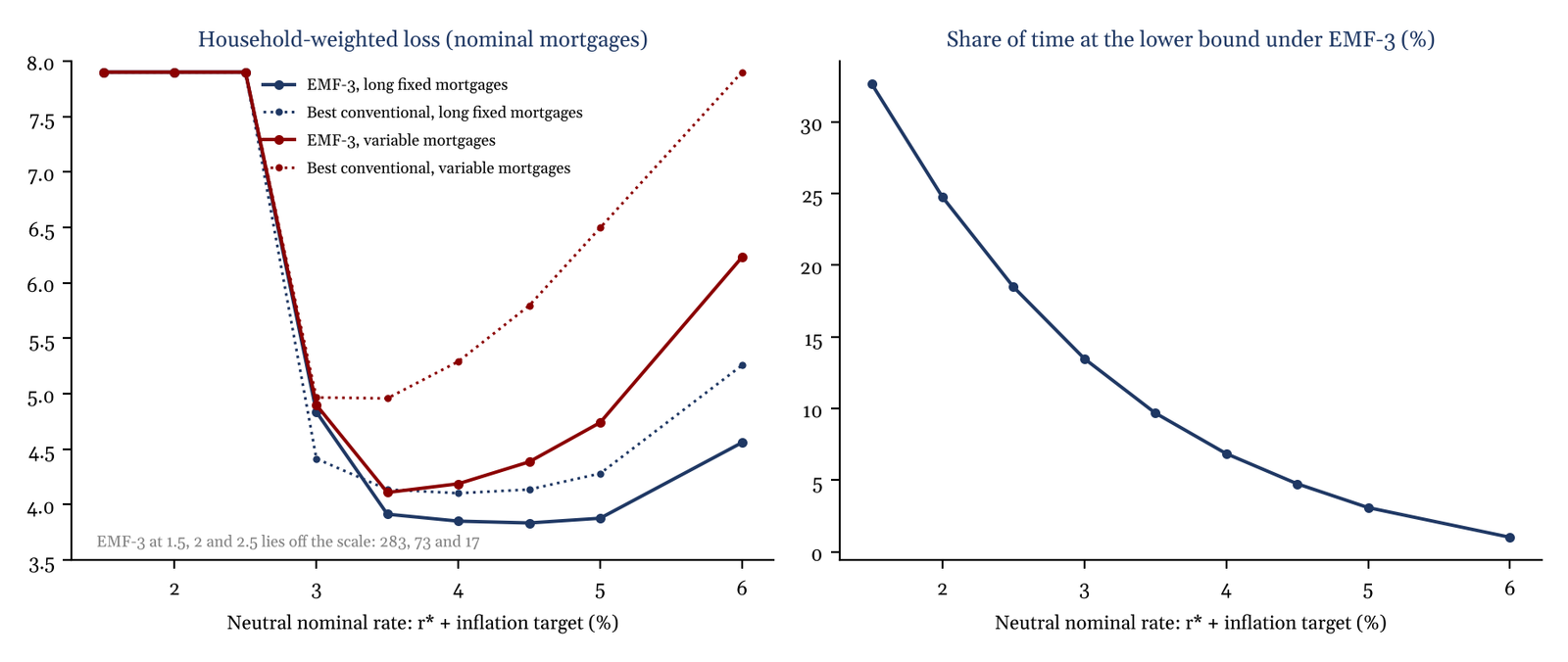
[Derived] The floor dominates below three points of neutral nominal rate. The mortgage tilt dominates above five, and much more where mortgages float. The good range is the same for every rule, and EMF-3 is the better rule inside it.
What that means for the target
Table 4. Best target by neutral real rate and mortgage structure (EMF-3)
| Neutral real rate | Long fixed, nominal | Variable, nominal | Variable, indexed | EMF-3 vs conventional at the best target |
|---|---|---|---|---|
| 0.5% | 3–4% (3.91 at 3%, 3.83 at 4%) | 3% (4.11) | 4% (3.89) | −7% (fixed), −17% (variable) |
| 1.0% | 3% (3.85) | 3% (4.19) | 3–4% (3.97 / 3.92) | −6% (fixed), −21% (variable) |
| 2.0% | 2% (3.85) | 2% (4.19) | 2–4% (4.19 / 4.14 / 4.13) | −6% (fixed), −21% (variable) |
[Derived] Household-weighted loss in brackets. Where two or three targets are listed, their losses are within about 2 per cent of each other, which is inside the precision of a model of this kind.
The rule that emerges is simple enough to state in one line: set the target so that the neutral nominal rate is about four, that is roughly four minus the neutral real rate, and lean to the lower end where mortgages float. Where the neutral real rate is 2, the 2 per cent convention is right. Where it is 1, the right target is 3 per cent. Where it is half a point, it is 3 to 4 per cent, the range Blanchard, Ball and others proposed for exactly this reason. The 2 per cent target is not false; it is the right answer to a question about room that was asked when the neutral real rate was about 2, and it is the wrong answer wherever that rate has fallen and stayed down.
The cost of inflation at which the answer changes
None of this counts the cost of inflation itself. To find the cost at which it would reverse the recommendation, I divide the gain from a higher target by the increase in the average squared level of inflation it brings. The result is the weight, in the same units as the loss, at which a squared point of steady inflation would exactly cancel the gain.
Table 5. Break-even cost of the inflation level for raising the target
| Neutral real rate and mortgages | 2% → 3% | 3% → 4% |
|---|---|---|
| 0.5%, fixed or variable | Pays at any cost | Fixed: 0.012; variable: does not pay |
| 1.0%, long fixed | 0.25 | Does not pay |
| 1.0%, variable nominal | 0.16 | Does not pay |
| 1.0%, variable indexed | 0.23 | 0.008 |
| 2.0%, any nominal | Does not pay | Does not pay |
| 2.0%, indexed | 0.010–0.013 | 0.002–0.003 |
[Derived] “Pays at any cost” means the higher target lowers the loss even before the level of inflation is counted, and lowers the average squared inflation as well, because it removes deflationary spells. A break-even of 0.25 means that raising the target from 2 to 3 per cent pays unless a squared point of steady inflation costs more than a quarter of a squared point of inflation missing its target.
The table separates two decisions that the public debate runs together. Restoring room, moving from 2 to 3 per cent where the neutral real rate is 1, is worth a great deal: the gain equals the cost of inflation missing its target by about one point every quarter, indefinitely, and it is cancelled only if the level cost is large. Going beyond the room the economy needs, from 3 to 4 per cent in the same economy, is worth almost nothing, and any plausible cost of inflation outweighs it. [Inference] A central bank that raises its target to restore room is making a defensible trade. One that raises it further is buying little and paying for it in the purchasing power of savings and wages.
The mortgage tilt
Where mortgages float, the case for a higher target is weaker than the arithmetic of room alone suggests. With a neutral real rate of 2, moving from 2 to 3 per cent raises the household-weighted loss under EMF-3 from 4.19 to 4.74, and moving to 4 per cent raises it to 6.23, because debt service rises with the nominal rate on every resetting loan. Figure 2 shows that inflation-indexed mortgages remove the penalty entirely: with them, targets of 2, 3 and 4 per cent give losses of 4.19, 4.14 and 4.13. A country that wants the protection of a higher target without the cost to its borrowers has to change how its mortgages are written as well as its target.
Figure 2. The tilt: household loss by target, neutral real rate 2 per cent, variable-rate mortgages
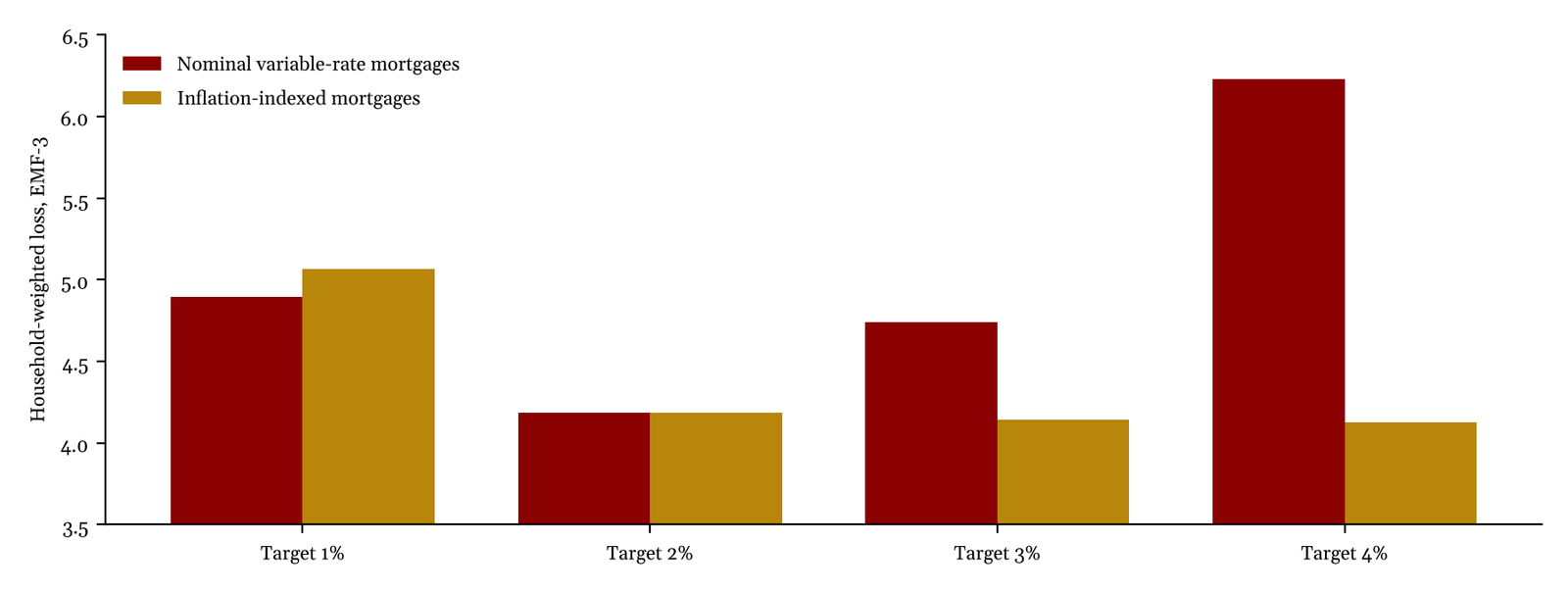
[Derived] On nominal mortgages a higher target raises every borrower’s payments; on indexed mortgages it does not.
A band
A target range of 1 to 3 per cent, inside which the policy rate responds to inflation at a third of its normal strength, is often proposed as a more honest description of what central banks can achieve. In this model it makes no measurable difference: with a neutral real rate of 2 the household loss is 3.86 against 3.85 for the point target, and inflation error is 1.40 against 1.39; at other rates and mortgage structures the differences are similar. The band therefore fails the criterion I set for it. [Inference] Its case, if it has one, is about communication and credibility, which a backward-looking model cannot assess, not about outcomes.
V. Making the cap pay for itself
The earlier paper found that a cap of half a point a year on upward mortgage resets did more for households in a variable-rate economy than any change to the policy rule. It also noted that the cap is not free. Because mortgage rates rise slowly under the cap but fall freely, the capped rate sits on average 1.4 points below the path it would otherwise follow, in an economy with a neutral real rate of 2, a 2 per cent target and variable-rate mortgages. That is the actuarially fair premium: the cost of the cap if it were insured. Table 6 shows what happens under each answer to who pays.
Table 6. Half-point reset cap, variable-rate mortgages, neutral real rate 2, target 2: household loss
| Design | EMF-3 | vs no cap | Best conventional | vs no cap |
|---|---|---|---|---|
| No cap | 4.19 | — | 5.29 | — |
| Deferral: forgone interest added to the balance, repaid over 12 years, no premium | 3.93 | −6% | 4.31 | −18% |
| Insurance outside the banks at the fair premium (1.4 points EMF-3, 1.6 conventional) | 4.00 | −4% | 4.39 | −17% |
| Absorbed by bank capital, no premium, mild pass-through | 8.52 | +103% | 10.20 | +93% |
| Absorbed by bank capital, 2-point premium, mild pass-through | 4.31 | +3% | 4.61 | −13% |
| Absorbed by bank capital, no premium, base pass-through | 183.5 | — | 260.0 | — |
[Derived] Losses at the fair premium are interpolated between the tested premiums. Under insurance the cap still pays up to a premium of about 1.9 points; under deferral it pays up to a premium of about 0.9 points, though deferral needs none because the borrower repays what was deferred. A one-point cap gives smaller gains in both designs (−3% as deferral, −3% insured) and is also harmful when absorbed by bank capital.
Two designs work and one does not. Deferral, in which the interest the cap holds back is added to the loan and repaid over the following years, is the best: it smooths the shock to payments when rates rise and asks for nothing in return except time. Insurance funded outside the banks, through a premium charged on capped loans and pooled in a fund, works almost as well even at the full fair premium, because what households buy is protection against a sudden jump in payments during a downturn, and that protection is worth more to them than its average cost. The design that fails is the one most likely to be enacted by accident: a cap imposed on lenders without a premium, whose cost falls on bank capital. The forgone interest accumulates as a capital shortfall, the shortfall raises credit spreads and restrains lending, and the recession that follows drives the economy towards the floor. Even with a premium, under mild pass-through it leaves households slightly worse off than no cap under EMF-3. [Inference] The adjustable-rate mortgages of the last housing boom, many of which let unpaid interest pile onto the balance until a sudden recast, are the warning: deferral works when it is repaid on a schedule set in advance and the lender is funded for it.
Figure 3. Half-point reset cap: household loss by premium and by who bears the forgone interest
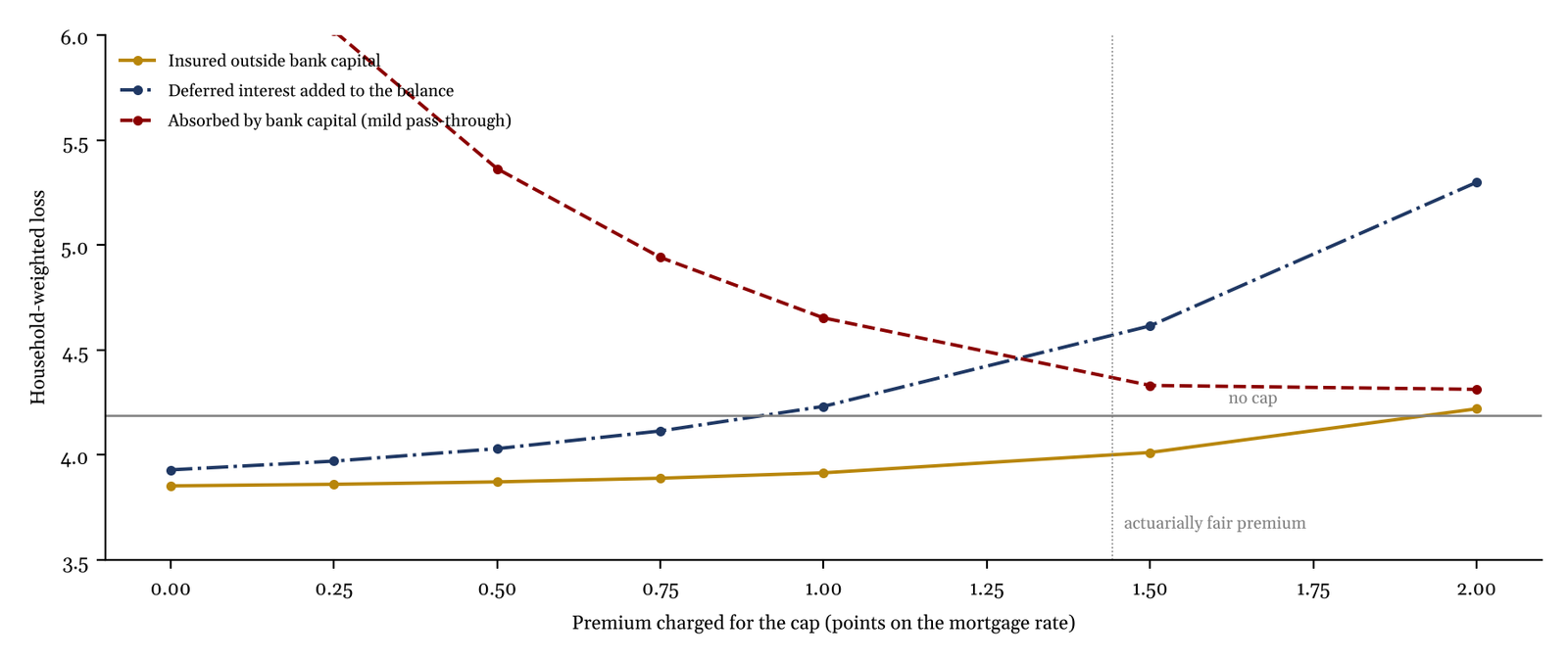
[Derived] Insured outside the banks, the cap beats no cap up to a premium of about 1.9 points, comfortably above the fair premium of 1.4. Absorbed by bank capital, it does not beat no cap at any premium tested.
VI. Guidance
The three papers together yield a framework a central bank and a government could adopt, and this one adds the parameters that were missing. I set them out as the rules I would recommend, each tied to the evidence on which it rests.
| Rule | Basis |
|---|---|
| 1. Set the inflation target from the room it buys, not from convention: aim for a neutral nominal rate of about four, so the target is roughly four minus the best estimate of the neutral real rate. | Table 3, Table 4 |
| 2. Restore room, but do not go beyond it. Raising the target to reach a neutral nominal rate of four is worth a great deal; raising it further is worth almost nothing. | Table 5 |
| 3. Review the target on a fixed schedule, for example every five years, against the latest estimates of the neutral real rate, and move it in steps of no more than a point. | Inference |
| 4. Where mortgages float, stay at the lower end of the range, or pair a higher target with inflation-indexed mortgages. | Figure 2 |
| 5. Prefer a point target. A band changes nothing measurable and gives up the clarity of a single number. | Section IV |
| 6. Run the policy rate by the EMF rule, with the credit instrument and fast supply relief, and stand both down as the rate approaches the floor. | Table 1; The Better Ways |
| 7. Cap upward mortgage resets at half a point a year by deferral repaid on a schedule, or by insurance funded outside the banks at a fair premium. Never let the cost of a cap fall on bank capital. | Table 6 |
These rules answer the complaint with which this programme began, that monetary policy is run to hit a number at the expense of the people who live with the consequences. The number is not arbitrary, but it is not fixed either: it should follow the room the economy needs. The instrument should not do everything: it should be helped by tools that act on credit and on supply, and those tools should step aside when the instrument has no room. And the cost of fighting inflation should not land on households through their mortgage payments: it can be spread over time, insured, or written out of the contract altogether.
VII. Limits
The model is backward-looking, and that matters more here than in the earlier papers. Its losses at the floor are large because nothing in it lets a credible promise to keep rates low later do some of the work that cannot be done now; in models with forward-looking expectations the floor is less costly, and the room needed would be smaller than five points. The rule of four should therefore be read as an upper estimate of the room an economy needs. Changing the target may itself unsettle expectations, a cost this model cannot see. The cost of inflation is not modelled; it is replaced by a break-even, and readers must bring their own view of it. The neutral real rate is treated as known, when in practice its estimates are imprecise and revised. The pass-through of bank capital losses into spreads and output is assumed, not estimated, and the deferral design assumes that deferred balances are repaid, which is a question of underwriting the model does not contain. Every number in this paper is model-dependent. The orderings are more robust than the magnitudes.
Table 7. The seam: principal claims by evidential status
| Claim | Status |
|---|---|
| Outcomes depend on the neutral nominal rate, and are best near four with a floor of −1 | Derived |
| The right target is roughly four minus the neutral real rate; 2% where it is 2, 3% where it is 1 | Derived; inference as policy |
| Raising the target beyond the room needed is worth almost nothing | Derived |
| On nominal variable-rate mortgages a higher target raises household loss; indexation removes the cost | Derived |
| A 1–3% band is indistinguishable from a 2% point target in outcomes | Derived |
| A reset cap works as repaid deferral or outside insurance and fails when absorbed by bank capital | Derived; pass-through assumed |
| Supply relief and credit tightening must stand down near the floor | Derived |
| Published estimates of the neutral real rate fell after 2008 | Witnessed in the literature |
Method note
The model adds to that of The Better Ways the floor gate, indexed mortgages, a band and the banking channels described in Section II; with them switched off it reproduces the earlier model exactly. Rules keep the coefficients tuned in the earlier paper, so no result here comes from re-tuning. Each configuration is evaluated across the same fifty-four economies, two hundred paths of 160 quarters each after a burn-in of forty, with the same test shocks. The decision criteria in Table 2 were written down before the run. Two corrections were made during the work and are reported: the floor gate, introduced after EMF-2 was found to underperform at low room, and a correction to the first specification of the bank channel, which had let the spread caused by the cap feed back into the cap’s own benchmark.
References
Ball, L. (2014), “The Case for a Long-Run Inflation Target of Four Percent”, IMF Working Paper 14/92.
Blanchard, O., G. Dell’Ariccia and P. Mauro (2010), “Rethinking Macroeconomic Policy”, IMF Staff Position Note 10/03.
Nakamura, E., J. Steinsson, P. Sun and D. Villar (2018), “The Elusive Costs of Inflation: Price Dispersion during the U.S. Great Inflation”, Quarterly Journal of Economics 133.
Rudebusch, G. and L. Svensson (1999), “Policy Rules for Inflation Targeting”, in J. Taylor (ed.), Monetary Policy Rules, University of Chicago Press.
Download the PDF
About the Author
Dr. Glen Brown is President & CEO of Global Financial Engineering, Inc. and Global Accountancy Institute, Inc. He is the architect of the GCPIAUT framework and the broader GATS-native proprietary capital doctrine. His work focuses on sovereign capital governance, algorithmic trading architecture, reserve-first compounding systems, and institutional financial engineering within closed proprietary environments.
Business Model Clarification
Global Financial Engineering, Inc. and Global Accountancy Institute, Inc. operate as closed-loop proprietary institutions. They do not offer public investment products and do not invite retail participation into their proprietary capital architecture. This paper is policy research published for intellectual and institutional discussion.
Disclaimer
This paper is analysis, not advice. It takes no position on any particular decision of any central bank or government, and nothing in it constitutes investment advice, an offer, a solicitation, or a recommendation to buy or sell any financial instrument.